

Jason Martin (Jersey, Great Britain, 1970) lives and works between London and the Portuguese region of Alentejo. He rose to international prominence with “Sensation: Young British Artists from the Saatchi Collection” (London, 1997). He has since exhibited in major museums, including CAC Málaga and Es Baluard in Palma (2008), the Peggy Guggenheim Collection in Venice (2009), the Fine Art Society in London (2010) and SCHAUWERK in Sindelfingen (2017). He has received significant recognition at events such as the Liverpool Biennial of Contemporary Art (1999) and the European Biennial of the Visual Arts of La Spezia (2000). His work has also been presented in major international exhibition projects, including “London Calling. British Art Today. From David Hockney to Idris Khan” (Fundación Bancaja, Valencia, 2021) and are included in numerous prestigious museum collections worldwide.
«I was born on a very small island [Jersey, 1970]. Up until I was in my late teens I never saw a horizon that wasn’t the meeting of sea and sky. I was exposed to the drama of an environment that always fell influence to the natural elements.»
When Jason Martin talks about his childhood, his deep connection with nature emerges, leading him to leave London in 2007 for Portugal, his grandmother's homeland. Today, the artist lives and works between the frenetic English metropolis and the tranquil Melides. It was an unconventional choice for an artist fresh from the acclaim of Sensation: Young British Artists from the Saatchi Collection (1997), followed by recognition at the Liverpool Biennial of Contemporary Art (1999) and the European Biennial of the Visual Arts in La Spezia (2000). His works are included in prestigious museum and private collections and are exhibited in leading internationally renowned galleries.


After spending several years in Lisbon, where he converted a former nightclub into an art studio, Jason Martin moved to the countryside of Comporta in 2015. Here, award-winning architect Souto de Moura converted a former agricultural warehouse into a creative retreat for him, surrounded only by vast rice fields. More recently, he finally settled in nearby Melides, in the peaceful Alentejo region, between the ocean and a plain of extraordinary biodiversity. «I always identify nature as the model to which painting should aspire. I experiment with nature and use it, but I don't imitate it» says the artist. These words translate into a concrete life choice when, in 2013, Martin purchases a 2.5-hectare vineyard and starts producing wine with handmade bottles, culminating in the Impossible Vineyards edition (2013). This experimental attitude runs through the entire work of Martin, known for redefining the language of painting. The British artist reinterprets the great masters of the 20th century, starting with their specific gestures: «Artists at the turn of the century painted with their wrists. Braque and Picasso, to create their cubist paintings, drew lines by articulating movements with their elbows. De Kooning, with his shoulder, made even broader brushstrokes. Finally, Pollock laid the canvas on the floor and painted with his whole body». Through a personal technique, Jason Martin blends abstract expressionism, action painting, and art aimed at erasing all traces of the body, «as if I had filled the empty vessel of minimalism», he says. Another example of this openness to the most original creative languages is the design of the Lady Dior bag (2016). It is in this self-imposed exile that Jason Martin refines his unmistakable aesthetic. As he stated during his solo exhibition at the Peggy Guggenheim Collection in Venice in 2009, his is a “mono-language” without waste: every gesture, every pour of oil falls onto the surface, composing abstract landscapes that defy categorization. «I mull over the ultimate meaning of a work for hours. Each painting has a very specific emotional identity», says the artist. In Martin's work, the pictorial material itself becomes landscape. The color is applied with brushes, spatulas, blades, and industrial combs, tools that allow him to engrave, comb, and shape the surface with an almost sculptural gesture, generating a synesthetic language where every mark becomes - in the artist's words - «testimony to time». Following the trail left by these “alternative brushes”, the viewer retraces the creative gesture and discovers works that stand on a double threshold: between painting and sculpture, due to their pronounced material and three-dimensional impact; between abstraction and landscape, as the surfaces seem to allude to horizons or natural flows, rendering an almost atmospheric perception of space. An abstraction that reinterprets and surpasses the expressionism of Franz Kline and the modernism of Robert Ryman - studied at Goldsmiths University in London. Gesture, technique, and visual result collide in a single concept, which represents Martin's true hallmark: energy. Each painting seems to contain the artist's gesture still in progress, as if the creative act had never ended and the surface continued to record its trace.

«I’ve reduced the methodology of how I make oils. If you don’t confine yourself to a set of rules, you can’t make value judgements about the direction of your work. I’ve stripped out the self-conscious movement of the body. [...] I’m using tools to facilitate a way in which the material can allow itself to become something contemporary, that hasn’t been seen before. I set up a controlled situation that allows for chance, which leads to exciting results.»

Tantra, 2025
Oil on aluminium, 160x130x10 cm

Virgo, 2025
Oil on aluminium, 285x190x10 cm
Jason Martin with Breathe With Me, 2025
Oil on aluminium, 200x160x10 cm
«Leon Battista Alberti already understood this: painting recreates the illusion of depth on the surface. We are used to seeing something that goes beyond the flatness of the canvas. The painting is a threshold where a dialectic between surface and illusion is created. And the challenge is to look through, to see beyond.»

Untitled (Ultramarine blue, Prussian blue), 2022
Mixed media on aluminium, 192x146x14 cm

Charlemagne, 2025
Mixed media on aluminium, 140x50x10 cm

Down We Go, 2023
Oil and graphite on aluminium, 230x200x15 cm

Flip Turn River, 2023
Oil and graphite on aluminium, 134x114x10 cm

We Walk, 2023 and We Walk There, 2023
Oil and graphite on aluminium, 156x358x15 cm each
Exhibitions

Essential Readings

NOMAD. Jason Martin
2008
exhibition catalogue
CAC Màlaga, Es Baluard de Palma

Vigil. Jason Martin
2009
exhibition catalogue
Peggy Guggenheim Collection, Venice
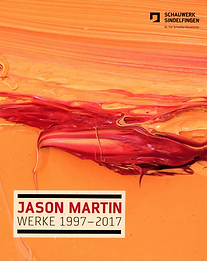
Jason Martin. Werke 1997-2017
2018
exhibition catalogue
Schauwerk Sindelfingen,
The Schaufler Foundation
