
PAOLO CANEVARI

Since his first solo exhibition in 1991, Paolo Canevari (Rome, 1963) has developed a language that transforms everyday objects into instruments of memory and reflection, experimenting with different media - from drawing to video, from performance to large installations. In 2002, Canevari held his first solo show at Christian Stein Gallery in Milan, Colosso. He has participated in numerous international exhibitions: Liverpool Biennial (2004); Whitney Biennial (2006); Venice Biennial (2007). Solo exhibitions include: Black Stone (2005) and ThANKS (2009) at Christian Stein Gallery; Nothing from Nothing curated by Danilo Eccher at MACRO in Rome (2007); Nobody Knows curated by Germano Celant at Luigi Pecci Center in Prato (2010); Decalogo curated by Antonella Renzitti at the Calcografia in Rome (2008) and later, curated by Brett Littman, at The Drawing Center in New York (2011); Monuments of the Memory (2013) and a major retrospective in 2019 at the Stein Gallery; Materia Oscura (2020) curated by Marco Tonelli and Lorenzo Fiorucci at Palazzo Collicola in Spoleto; Good year (2024) at National Museums of Perugia. Among his most significant projects: the installation of Souvenir (2015), a permanent work in Olnick Spanu Art Program space in Garrison (NY), accompanied by a publication with texts by Brett Littman and Robert Storr; participation in the group show Challenging Beauty – Insights of Italian Contemporary Art (2015) at Parkview Green Contemporary Art Museum in Beijing and at the Bangkok Biennial (2018) with Monuments of the Memory, the Golden Room. His works have been presented in prestigious institutions such as Galleria Nazionale, MAXXI, and MACRO in Rome, MART in Rovereto, Museion in Bolzano, Fondation Louis Vuitton in Paris, Drawing Center and MoMA in New York, IMMA in Dublin, and KW in Berlin.
The Artworks. From Historical Memory to the Critical Issues of the Present
March '63: memories of an elevator
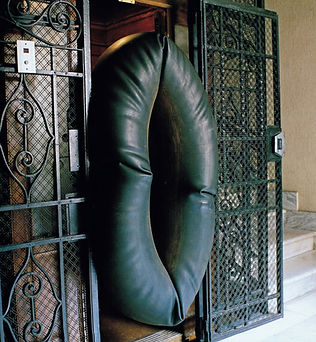
Mama, 2000
An elevator takes on the appearance of a giant female reproductive organ, ready for imminent birth: it is Mama (2000). A perhaps unsettling image, but this is how Canevari evokes his own birth, which took place in an elevator in March 1963. The work is composed of a large inner tube with gentle yet contracted curves, which the artist places each time in different settings: a chapel, where it seems to frame an ancient Madonna and Child, or an empty room, in which a naked man is tied to a symbolic umbilical cord.
All roads lead to Rome

Burning Colosseum, 2006
Burning Colosseum: a rubber Colosseum burns in flames. It is not an act of mere destruction, but a theatrical scene in which the opera appears as a comedian of the Latin theatre, and Rome as its stage. Thus, at the Non-Catholic Cemetery, inner tubes become funeral wreaths that, deflating, seem to breathe their last (Last Breath, 1999). In the Roman Forum, tires renamed as great leaders are arranged in a sort of immobile procession (Popolo di Roma, 2000).
Monuments of the Memory
%2C%202019_edited.jpg)
Black Pages (Monuments of the Memory), 2019
Monuments of the Memory is a series begun in 2011, featuring diverse works: empty glass cases, gilded panels, black monochromes, and landscapes painted with used motor oil. The image - or its absence - serves both as a testimony and as an erasure of what once has been. In Black Pages, a page from the 1964 newspaper of L’Unità, dedicated to the death of Palmiro Togliatti, is enclosed in a baroque frame and overshadowed with motor oil, symbolizing our tendency to overwrite history.
«I can't pretend to be innocent»
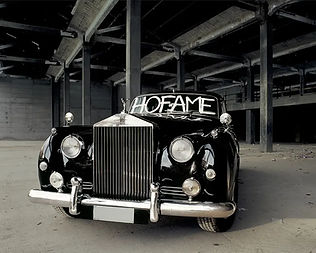
Ho fame, 2020
Museo Novecento, Florence & OFF
Canevari's provocations enter the urban space with Ho fame [I'm hungry], an installation in which a cry for help defaces the windshield of a Rolls Royce. The work originates from the homeless signs collected for years, transformed into a public art gesture that highlights their dramatic nature. «I cannot pretend to be innocent» Canevari states, acknowledging his own responsibility in the face of a reality marked by inequality and widespread indifference.
The most serious game in the world

Swing, 2005
Patong Beach, Thailandia
The absurdity of power

ThANKS, 2009
Galleria Christian Stein, Milano
Rubber tanks and a bomb disguised as a strobe light, emptied of their gravity, transform Christian Stein Gallery into «a delirious environment, halfway between a night-time bombing and a nightclub, which attests to the complementarity of mutual idiocies oscillating with the same attitude between massacre and entertainment» (G. Celant, 2010). Thus the symbols of power appear in all their absurdity, fascinating and disturbing at the same time.
In 2005, Patong Beach in Thailand was transformed into a playground, but with unusual swings. Children swing on tires, each bearing the name of a religion. It is a role-playing game. Each child impersonates a believer - Catholic, Protestant, Muslim, Jewish, Buddhist - and, with genuine lightheartedness, has fun with one of the most serious things in the adult world, the thing for which life is praised and wars are waged: faith.
Colosso, 2002
Galleria Christian Stein Milano

The performance Colosso (2002) takes place during the opening of the exhibition of the same name at Galleria Christian Stein in Milan, where Paolo Canevari carries a tire engraved in the shape of the Colosseum on his shoulders. The posture is unnatural: the artist transforms himself into a living caryatid, supporting the weight of a historical symbol that has become industrial waste. As the hours pass, the fatigue becomes evident and some visitors, overcome by empathy, break the distance imposed by the performance and approach to offer him help.
Seed, 2004
New York City

Seed (2004) originates on the roof of Paolo Canevari's New York house, on Grand Street, where the artist threw a cardboard bomb up into the air, aligned with his body. The photographs of that gesture later became a limited series of black and white posters to be affixed on the streets of New York. The unauthorized posting got him arrested, confirming how artistic action, when it invades public space, can transform into a direct confrontation with the reality it addresses.
To My Students, 2025
Litografia Bulla, Roma

Professor at the Academy of Fine Arts, Canevari entrusted his skin to thirteen students, who covered his right arm with tattoos. The drawings, arranged as a "map of human relationships", were transferred to stone and reproduced on paper in a limited edition. Furthermore, To My Students (2025) becomes a performance: covered by a black curtain, Canevari shows only his tattooed arm, transforming it into a symbol of an indelible and collective bond between the Master and his students.
Video


Past Exhibitions

2019, Oct. 12
PAOLO CANEVARI
Pero, via Monti 46
2013, June 06
PAOLO CANEVARI
Monuments of the Memory
Milano, corso Monforte 23
2011, Feb. 24
VIAGGIANDO
Group Show
Milano, corso Monforte 23
2009, Mar. 26
PAOLO CANEVARI
Decalogo
Christian Stein Edizioni, Milano
2009, Mar. 26
PAOLO CANEVARI
ThANKS
Milano, corso Monforte 23
2007, May 30
OPERE DALLA COLLEZIONE CHRISTIAN STEIN
Group Show
Milano, via Gallarate 221 | Pero, via Monti 46
2005, Oct. 27
PAOLO CANEVARI
Black Stone
Milano, corso Monforte 23
2002, Nov. 21
PAOLO CANEVARI
Colosso
Milano, corso Monforte 23
Essential Readings
Nothing From Nothing
Danilo Eccher

Published on the occasion of the solo exhibition Nothing From Nothing at MACRO Museum in Rome (May 25 - September 30,2007), this volume includes essays by Klaus Biesenbach, Danilo Eccher, Alanna Heiss and Chrissie Iles.
Electa, 2007
ISBN 9788837051839
Nobody Knows
Germano Celant
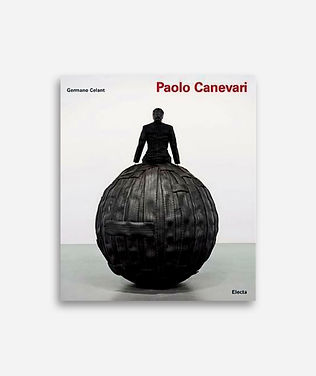
Germano Celant curates a great retrospective of Paolo Canevari's work, Nobody Knows, at the Luigi Pecci Centre for Contemporary Art in Prato (March 20 – August 1, 2010) and the comprehensive catalogue and enriched by the artist's own words.
Electa, 2010
ISBN 9788837076030
Manuale per giovani artisti
Paolo Canevari

In this volume Paolo Canevari, professor at the Academy of Fine Arts, gathers a series of practical tips and observations on the art world, designed to guide - without concessions or rhetoric - young artists taking their first steps.
Dario Cimoreli Editore, 2024
ISBN 9791255610854
Literary collaborations
I tacchini non ringraziano [The turkeys don't say thank you]
Andrea Camilleri, Paolo Canevari


In this book Andrea Camilleri gathers together his tales dedicated to animals. Each animal seems to intuit the logic of human beings and, in its own way, use it or counter it with winning strategies: from the dignity of turkeys to the discretion of a snake. Camilleri, however, also reminds us that perhaps the world is now too harsh for the beauty of animals to truly find space. Canevari's illustrations accompany the stories with the same ruthless elegance: essential lines, never consolatory, which amplify Camilleri's affectionate cynicism without domesticating it.
Salani Editore, 2018
ISBN: 8893816156
Bocca mia taccio
Paolo Canevari, Luca Succhiarelli


"Bocca mia taccio" is the result of a collaboration between Paolo Canevari and the poet Luca Succhiarelli. The volume brings together thirty-nine poems accompanied by works from the Monuments of Memory series, in which Canevari explores form as the primary vehicle of meaning and the spectator's imaginative potential. Succhiarelli's texts, heirs to both ancient lyric poetry and the twentieth-century avant-garde, alternate playful rhythms and contemplation, ranging from irony to civic engagement. Images and texts appear side by side without overlapping, leaving the reader free to construct their own interpretation.
Silvana Editorial, 2021
ISBN: 9788836649730
Video interviews
The contemporary art museum on the hills of Amelia

An ancient ruin in the hills of Amelia, once owned by Marshal Diaz, became the Canevari family home in the 1980s, purchased by the artist's father after years it was left to crumble. In this video interview, Paolo Canevari guides us inside what is now a completely transformed residence: a place of work and experimentation, where every space reflects his approach to art, perfectly balancing memory, provocation, and dark irony.
The interiors feature furniture designed by the artist and made by Umbrian artisans: a chest of drawers inspired by the Roman she-wolf, chairs carved like small Colosseums, and vases made using the Etruscan buccheri technique.
In the large workshop on the ground floor, we find traces of Canevari's entire research: from the religious dimension to social criticism, from the revival of tradition to the working of modern or unusual materials. Among the latter, the rusty pipes of the Innocenti company, assembled in the large sculpture Innocenti (part of the Monuments of the Memory cycle, 2022). A tribute to victims at work, but also a reflection on representation and the possibility of monumentalizing what belongs to the harshest everyday life.
Dark Matter
The thorough exhibition at Palazzo Collicola
Decalogue
A project at Calcografia Nazionale in Rome
In conversation with Paolo Canevari
TalkingArt. Contemporary voices
The artist's craft
Academy of Fine Arts, Urbino